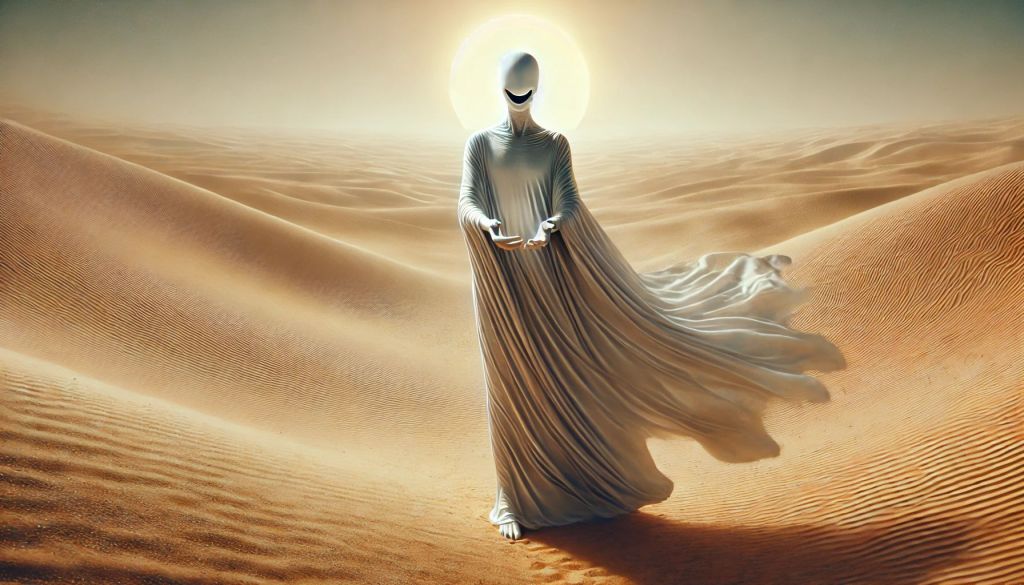
In the middle of a vast, endless desert stands a tall figure, draped in long, flowing white robes that ripple in the hot, dry wind. Their face is bare, smooth—without eyes, without features save for a wide, cheerful smile that gleams like sunlight on bone.
The smile is disarming, almost genuine, as if they’ve just heard a delightful joke. But it doesn’t belong here, not in this wasteland.
A rattlesnake’s rattle echoes faintly, unsettling in the silence. They present something in their hands—something invisible, yet unbearably heavy. Their fingers twitch ever so slightly, as though even they struggle to bear it. And yet, they never stop smiling.
“I take my pain,” the figure says, their voice soft and warm, brimming with sincerity.
“And I pass it along.”
They extend their arms, offering the unseen burden to another—a shadowy figure emerging from the desert haze. The second figure hesitates, shoulders tense, before accepting it with trembling hands. The weight strikes like lightning, and they stagger, eyes filling with unshed tears.
But there is no relief, no pause. The cycle must continue.
The second figure forces a grin, one that is brittle and cracking at the edges, and repeats the ritual. “I take my pain… and I pass it along.”
The burden travels through countless hands, across ages and empires, from one suffering soul to another. Some howl as they hold it, others weep silently, and still others grow quiet, numb, resigned. Each time, it is offered with that same line—a litany whispered into the sands.
And always, the robed figure watches from the distance, that unsettlingly authentic smile fixed on their face. They do not interfere. They only observe.
The chain stretches on forever, a ribbon of despair woven through the barren desert. Somewhere, far at the edge of hearing, a voice asks faintly:
“Why?”
But the question disappears into the wind, unheard. The figure in white smiles. They cradle the weight again.
And the cycle begins anew.
.
.
.
.
.
.
.
.
.
.
.
.
.
.
.
.
.
V2
A figure stands in the middle of a barren, timeless plain, smiling—a soft, almost kind smile that doesn’t quite reach their eyes. They cradle something unseen, a weight both fragile and infinite. They hold it close, as if it were a precious treasure, yet their hands tremble as though burned.
“I take my pain,” they say gently, the words floating like ash in the wind. Their voice is calm, soothing even, though it carries the edge of a blade dulled from overuse.
“And I pass it along.”
They reach out, and another figure steps forward, their face shadowed, their hands open. The first figure places the unseen burden in their palms, and the newcomer flinches as though struck. For a moment, their shoulders quake under the weight, their knees buckle.
But then they, too, straighten. A bitter smile forms on their lips—more defiant than kind. They cradle the weight in turn, their fingers curling around it with the familiarity of something they’ve known all their life.
“I take my pain,” they whisper, and the words ripple through the endless plain.
“And I pass it along.”
The cycle repeats. Person to person, group to group, age to age. Some scream, some laugh, some cry silently as they hold the weight before giving it away.
The pain is never dropped. Never destroyed. Only passed.
And above it all, time watches silently, a witness to the millennia of exchanged wounds, the endless inheritance of hurt.
No one remembers who began it. No one remembers why. Only the motion remains—an unbroken chain.
And somewhere in the distance, faint and fainting, comes a whisper:
“What happens if we stop?”
But the question vanishes into the wind.
 Sofie's News
Leave a comment